Investing in SME Units: ROI, Taxation, and Why Buying Pays Off
What do SME units yield as an investment? A practical guide on returns, tax benefits for Belgian SMEs, and the buy vs. rent consideration — based on 15+ years of experience from LCV Real Estate.
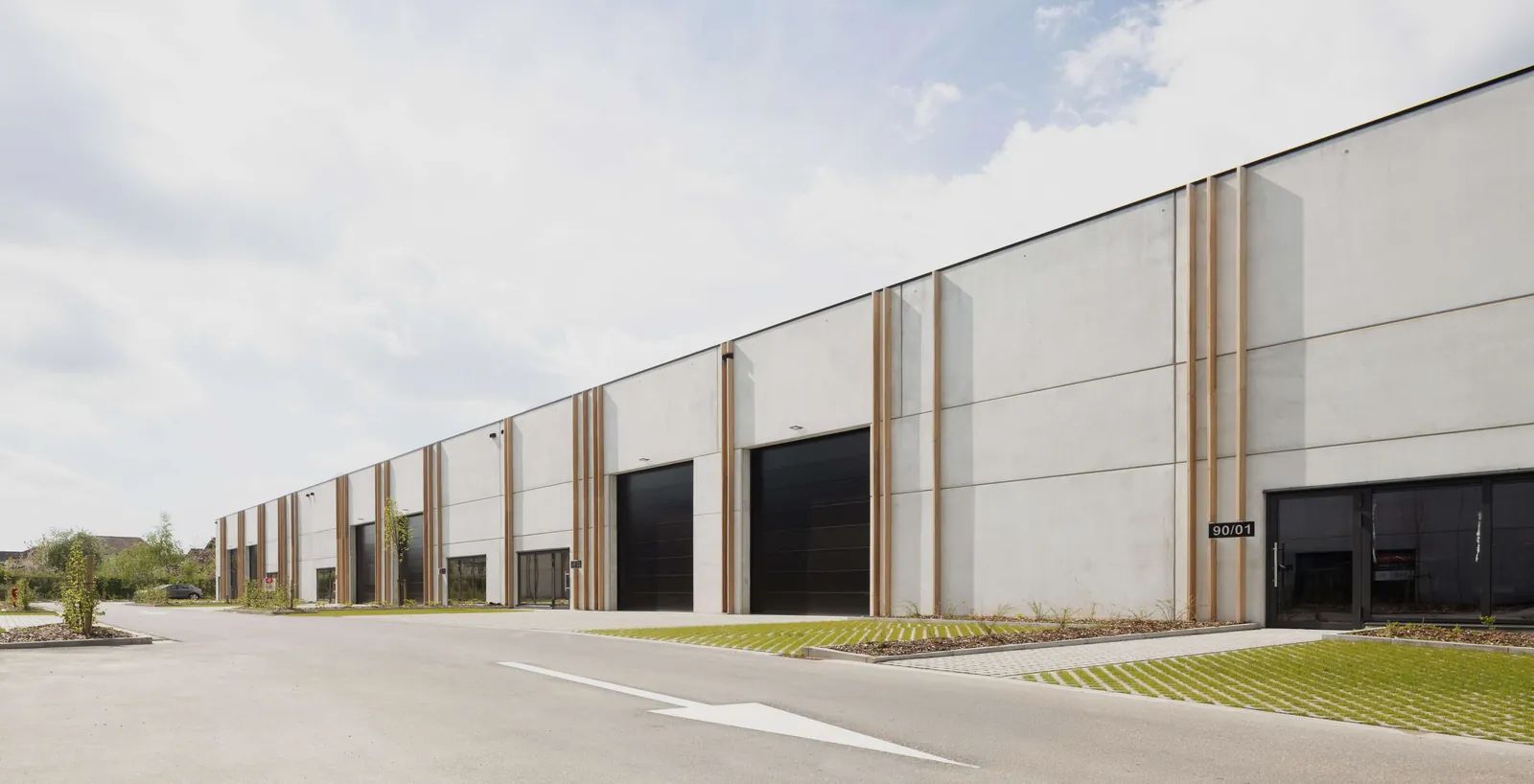
SME units have emerged in recent years as one of the most sought-after segments within Belgian commercial real estate. Entrepreneurs seek flexible space for production, storage, e-commerce, or service provision. Investors look for tangible, leasable properties with healthy and predictable returns. And the government continues to fiscally support entrepreneurship.
In this guide, we outline why purchasing SME units today represents a strong investment: what realistic returns you can expect, the fiscal advantages available in Belgium, and why ownership is almost always more advantageous than leasing in the long term.
"A well-chosen SME unit combines a gross rental yield of 6% to 8%, depreciations that reduce the taxable base, and a building that remains fully amortized and readily leasable after 20 years. For an SME operating within the unit, the 'rent' is furthermore removed from the cost structure, and the company actively builds its own equity."
1. What is an SME unit?
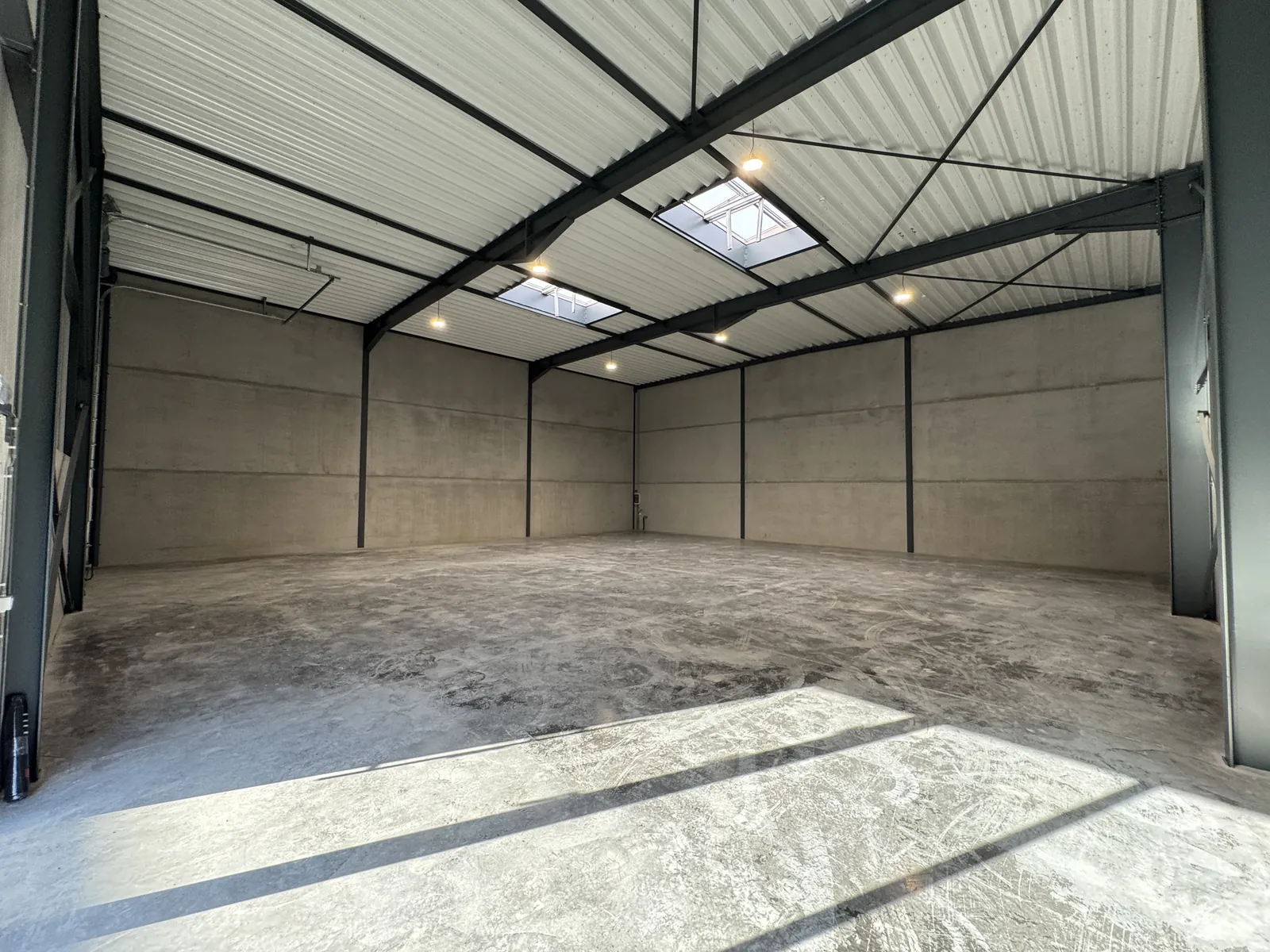
An SME unit is a modular business space — typically between 150 and 800 m² — located within a larger business park. Each unit features its own sectional door, personnel door, technical connections, and often a mezzanine or office module. They are designed for small and medium-sized enterprises that lack the scale (or budget) for a fully standalone property but desire the flexibility and representativeness of their own commercial real estate.
Typical users: • Tradesmen and contractors — storage of materials and equipment, workshop. • E-commerce & fulfilment — inventory, pick & pack, last-mile logistics. • Production & assembly — small production lines, finishing, custom work. • Service providers — showroom + warehouse combinations. • Investors — leasing to the aforementioned profiles.
2. Returns: What do SME units yield?
The return on an SME unit comprises three components that collectively determine the overall picture.
2.1 Gross rental yield
For new-build SME units in well-connected locations, we currently observe in the Belgian market: • A-location, new-build, standard m² → 5.5% – 6.5% gross yield • B-location, new-build → 6.5% – 7.5% • C-location or specialized market → 7.5% – 8.5% and more
Example calculation for a 400 m² unit purchased at €1,200/m² (€480,000 excl. VAT) and leased at €65/m²/year: • Annual rental income: 400 × €65 = €26,000 • Gross rental yield: €26,000 / €480,000 = 5.42%
2.2 Net yield after costs
Subtract from the gross rent: property tax, insurance, syndicate fees, maintenance, and a vacancy buffer (~5%). Net, typically 75% to 85% of the gross rent remains — in the example above, approximately €20,000 to €22,000 per year.
2.3 Capital appreciation and amortization
The true power of real estate lies in two often-overlooked components: 1. Capital Accumulation — when financed via a bank loan, the tenant effectively contributes to loan repayment. After 15 to 20 years, you own a debt-free property. 2. Appreciation — industrial real estate in Belgium has appreciated by an average of 3% to 5% per year over the past 10 years. Furthermore, building land for logistics and KMOs is becoming increasingly scarce due to stricter spatial planning regulations.
Total Return (IRR) over a 15 to 20-year period for well-chosen KMO units typically ranges between 8% and 11% net per annum — significantly higher than savings accounts, bonds, or average stock market returns, and with a much more predictable profile.
3. Tax Advantages for Belgian KMOs
Belgian tax legislation is remarkably favorable for KMOs that purchase their own business real estate through their company. Key leverage points include:
3.1 Depreciation
The building is depreciated within the company, typically over 20 to 33 years (construction) and installations over 10 years. Each year, you can deduct this depreciation from your taxable profit — a €400,000 building thus yields an annual tax benefit of ±€20,000 in depreciation costs.
3.2 Deductible Interest
Interest on the investment loan is fully deductible as a business expense. In the initial years of a loan, this interest represents a substantial portion of the repayment, further reducing the taxable base.
3.3 Reduced KMO Corporate Tax Rate
KMOs that meet the conditions pay only 20% corporate tax on the first €100,000 of profit (instead of 25%). Depreciation and deductible interest further help to frequently leverage this threshold in your favor.
3.4 Investment Deduction
The increased investment deduction for KMOs — including the thematic deduction for energy-efficient investments such as solar panels, heat pumps, and charging infrastructure on your KMO unit — provides an additional tax advantage on top of standard depreciation. This is particularly relevant now that new-build KMO units are typically equipped with PV and heat pumps as standard.
3.5 VAT Recovery
Upon purchasing a new-build KMO unit under the VAT regime (21%), the VAT is fully recoverable for professional users. On a €480,000 purchase price, this translates to a cash flow advantage of ±€100,000 that you do not definitively have to bear.
"Tax regulations evolve and depend on your personal situation. Always have a concrete simulation validated by your accountant or tax advisor."
4. Buy or rent? The 20-year calculation
The classic comparison for a 400 m² unit: RENTING • Annual cost year 1: €26,000 rent • Tax deductible: fully • Cumulative cost after 20 years (2% indexation): ±€635,000 • Owner after 20 years: the landlord • Residual value on your balance sheet: €0 BUYING • Annual cost year 1: ±€24,000 repayment + €5,000 fixed costs • Tax deductible: interest + depreciation + costs • Cumulative cost after 20 years: loan repaid • Owner after 20 years: yourself — the asset is within your company • Property residual value: estimated €600,000 – €800,000
Conclusion — renting remains attractive for companies with highly fluctuating space requirements or a short time horizon (less than 5 years). For every SME with stable or growing activity and a horizon of 10+ years, buying is the superior choice, both from a cash flow and asset perspective.
Also read our broader considerations in the guide 'Buying or Renting SME Units': /nieuws/kmo-units-kopen-of-huren
5. What to look for when purchasing?
Not every SME unit is an equally good investment. The most important checklist: 1. Location & accessibility — proximity to motorway (< 5 km), visibility, smooth accessibility for trucks. 2. Construction quality & E-level — a lower E-level = lower energy cost = higher rentability and future value. 3. Standard equipment — sectional door ≥ 4 m high, clear height ≥ 6 m, sufficient mains power (400 V), prepared for PV and charging stations. 4. Legal structure — co-ownership vs. individual plot, basic deed, syndicate costs. 5. Developer — choose a party with a proven track record, financial stability, and delivery according to schedule.
LCV Real Estate has been developing and delivering SME units in Belgium, France, and Luxembourg for 15+ years — with 43 completed and ongoing projects and over 356,000 m² of commercial real estate. Our focus: speed of execution, high construction quality, and a long-term partnership with end-users and investors.
6. Ready to invest?
View the available offerings directly or match your investment profile with a specific project: • Available SME units: /beschikbaar • Expansion Matchmaker — find your ideal location: /matchmaker • Contact our team for an investment simulation: /contact
Frequently Asked Questions
What is the average cost of an SME unit in Belgium?
A new-build SME unit of 300 to 500 m² in a common location costs between €400,000 and €700,000 excl. VAT, depending on location, finishing level, and proportion of office space.
What is a realistic rental yield?
For quality new-builds in A/B locations: gross 5.5% to 7.5%. In more peripheral locations, this can go up to 8% and more.
Can I purchase an SME unit as a private individual?
Yes, however, the fiscal advantages (depreciation, VAT recovery, deductible interest) are exclusively applicable when purchased through a company. Please discuss this with your accountant beforehand.
What is the construction timeline for an SME unit?
At LCV Real Estate, we typically estimate 6 to 12 months from the signing of the preliminary agreement to the handover of keys, subject to permit approvals and bespoke requirements.
Are SME units future-proof?
Yes. The demand for flexible, energy-efficient business premises continues to grow structurally due to e-commerce, the relocation of production, and the scarcity of building land. Furthermore, new constructions featuring low E-levels, PV, heat pumps, and charging infrastructure are future-proof in terms of regulatory compliance.